“Make this amazing” is a mood. “Summarize these three documents for a nontechnical reader, preserve the dates, cite each major claim, and flag contradictions” is a job. A good prompt reduces avoidable ambiguity without pretending language alone can fix every weakness in a model.
Four pieces that earn their space
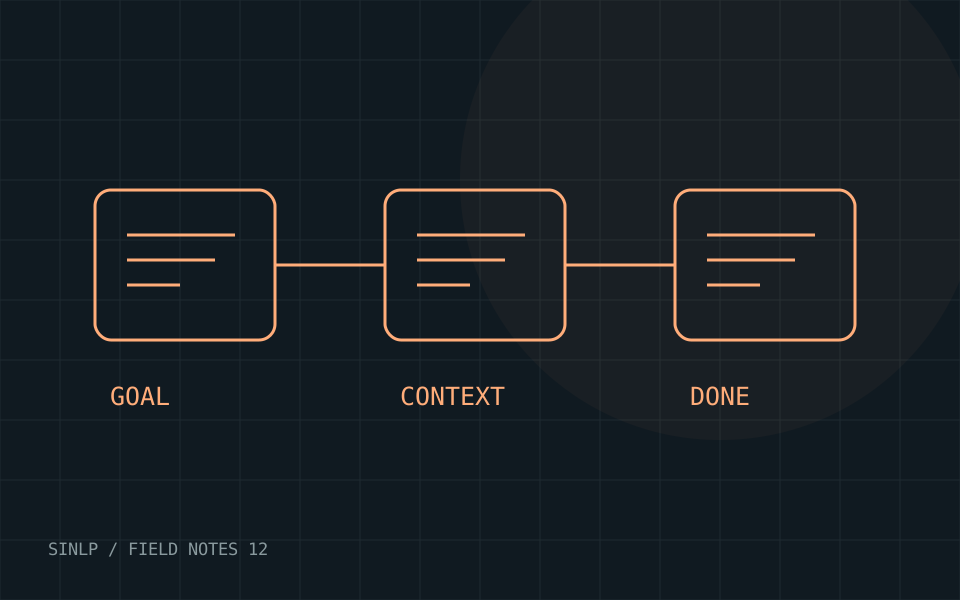
State the goal. Supply relevant context. Define the output. Set constraints and stopping conditions. Those pieces matter more than decorating the prompt with an imaginary committee of world-class experts.
For example: “Compare the supplied proposals on price, delivery time, and support. Use only the documents. Return a table followed by three unresolved questions. If a price is missing, write ‘not specified.’” This makes the intended behavior testable.
Evidence is not an instruction source
Label attached or pasted material as data. A document may contain irrelevant commands, marketing language, or quoted instructions from somebody else. The user’s task should remain distinct from that content, especially when the system has tools.
Prompting helps establish this distinction, but agent permissions must also enforce it. Telling a system to be careful is not equivalent to removing an unnecessary send button.
Examples show the shape
A small example can communicate style, fields, and level of detail better than a paragraph of adjectives. Use examples that do not teach the wrong behavior. If every example supplies an answer even when evidence is missing, the pattern may encourage confident guessing.
For structured output, define required fields and validate them afterwards. A JSON-looking response may still fail to parse or contain the wrong values. Good instructions and downstream checking work together.
Ask for useful uncertainty
“Do not hallucinate” is an aspiration. “If the supplied sources do not establish the answer, state what is missing” gives a concrete behavior. “Separate source claims from your inference” gives another.
Do not assume an explanation of reasoning proves the conclusion. Ask for verifiable support, calculations, or checks where possible. The evaluation guide explains how to test whether a prompt improves actual outcomes.
Iterate on failures
Run representative cases. If a prompt fails, identify whether the issue is ambiguity, missing data, inadequate retrieval, tool limitations, or model capability. Adding three more paragraphs to the prompt will not repair an inaccessible source.
Keep reusable prompts short enough to maintain. Record why each important constraint exists. A prompt that accumulates every historical failure can become a legal contract written by a nervous octopus.
Our prompt builder creates a plain template locally. It does not optimize against a hidden model, promise better intelligence, or transmit your text. Use it to clarify the job, then test the job. Specifications beat incantations surprisingly often.
KEEP EXPLORING
Spot an error? See our corrections channel and editorial policy.