A large language model produces language by learning patterns from data and using context to generate likely continuations. That sentence is accurate enough to get started and incomplete enough to hide a small city. Let us visit a few neighborhoods without buying a crystal.
Tokens are the working units
A token may be a word, part of a word, punctuation, or another text unit depending on the tokenizer. The model represents these units numerically. Context limits and usage costs often count tokens, which is why counting words alone gives an imperfect budget estimate.
English prose is often estimated at roughly four characters per token as a quick heuristic. Code, other languages, unusual spelling, and formatting can differ substantially. Our token estimate is labeled as an estimate and cannot replace the actual tokenizer for a particular model.
Attention is a mechanism, not mindfulness
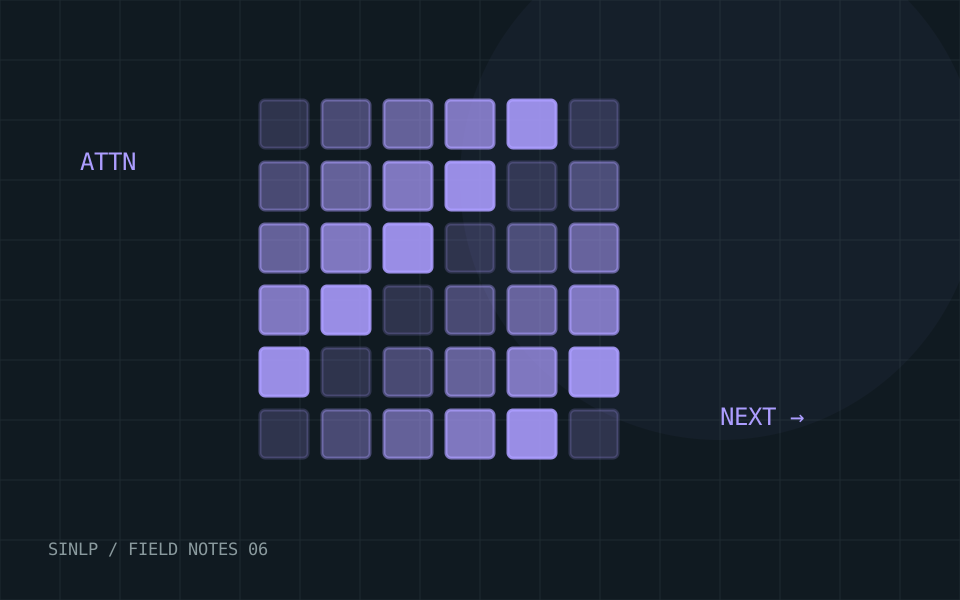
The Transformer paper introduced an architecture centered on attention mechanisms rather than the recurrent and convolutional approaches it compared against. Attention lets representations combine information from different positions in a sequence. It does not mean the system consciously pays attention in the human sense.
A useful analogy is a constantly updated set of cross-references. To process “it,” the system needs context that helps indicate what “it” refers to. Mathematical operations create context-sensitive representations; the analogy helps, but the model is not literally filling out an index card.
Training and use are different stages
During training, parameters change in response to an objective. During ordinary inference, the trained model uses its parameters and supplied context to produce output. Putting a correction into a conversation can influence that conversation without retraining the underlying model.
Post-training can shape how models follow instructions and respond to preferences. The InstructGPT research studied using human feedback to improve instruction following. That is evidence for a training approach; it is not a guarantee that every aligned model is truthful, unbiased, or safe in every situation.
Why fluent errors happen
Language generation and evidence verification are different operations. A system can produce a plausible citation or explanation when the supporting fact is absent. Some errors arise from weak knowledge, others from ambiguous instructions, poor retrieval, or a pressure to provide a complete-looking answer.
Giving the model a source can help, but it can still misread or misattribute it. Asking for uncertainty can help, but self-reported confidence is not calibrated evidence by default. Prefer answers whose important claims can be checked against accessible material.
Reasoning needs an outcome test
Some systems spend additional computation before returning an answer. That can improve performance on certain tasks. It does not turn a long explanation into a proof of correctness. Evaluate the result, and use independent checks where they are available: calculation, compilation, retrieval, or human review.
For a business workflow, the right question is whether the system completes the actual task reliably under your conditions. A model that passes a public benchmark may still mishandle your product codes. Your product codes, regrettably, did not attend the benchmark.
Build around the model’s strengths
Give clear goals, relevant context, and explicit output requirements. Keep sources distinct from instructions. Validate structured outputs before using them. Test what happens when information is missing. Decide which actions need approval before connecting tools.
LLMs are powerful components. A dependable system also needs data, evaluation, and boundaries. Continue with RAG for evidence retrieval and evaluation for the difference between convincing and correct.
KEEP EXPLORING
Spot an error? See our corrections channel and editorial policy.